
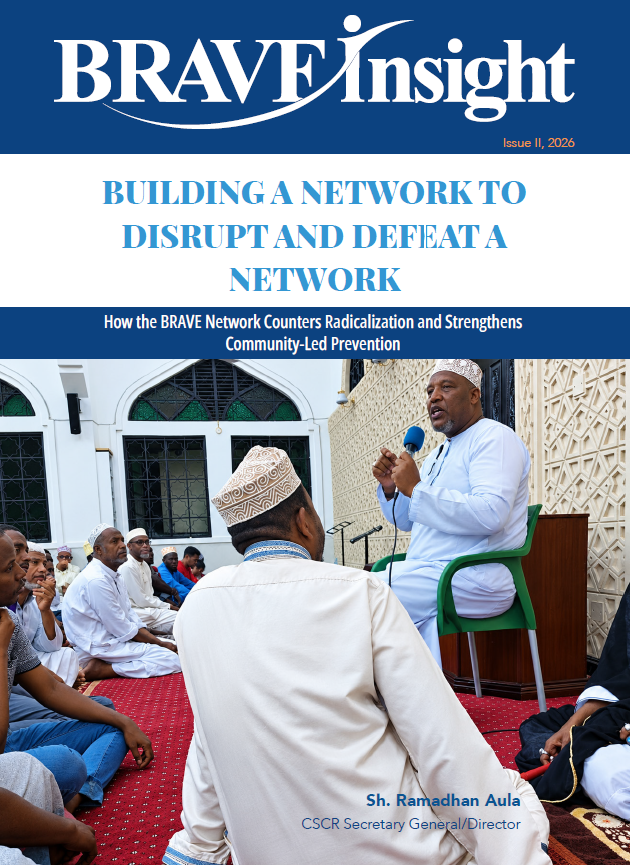
Brave Insight, Issue III, 2026 – Building a network to disrupt and defeat a network
Introduction
Violent extremism is sustained not only by ideology but also by social relationships, networks of trust, the formation of identity, and locally embedded systems of influence. Conventional responses that rely predominantly on state-centric enforcement may therefore struggle to reach the relational and community dimensions of radicalization. This paper examines the BRAVE (Building Resilience Against Violent Extremism) Network, a flagship initiative established in Kenya in
2015 by the Center for Sustainable Conflict Resolution (CSCR). CSCR main leaders, spearheading the programs included Sheikh Ibrahim Lethome, Dr Mustafa Y Ali (who is also the Convener for BRAVE), and this author. Drawing on the BRAVE model as presented by CSCR, the paper argues that community-based prevention networks offer a practical means of detecting early warning signs, providing credible religious guidance, challenging extremist narratives, and strengthening locally owned processes of prevention and reintegration. It offers a comparative conceptual account of extremist networks and the BRAVE Network, examining their structures, sources of legitimacy, modes of influence, and engagement with vulnerable populations. It also considers where BRAVE is reported to operate, the lessons learned, the challenges of implementation, and recommendations for policy. The analysis is descriptive and practice-oriented; it does not purport to offer a statistically causal evaluation of BRAVE’s impact. It concludes that sustainable prevention demands more than the disruption of extremist structures: it requires trusted, visible, culturally legitimate, and community-owned alternatives.