
How the Center for Sustainable Conflict Resolution is Addressing Fifth-Generation Extremism and Terrorism
By Ramadhan Aula, Director, CSCR
For twenty years, most counterterrorism doctrine was built to fight an enemy that no longer quite exists. It was built to defeat organizations that depended on state sponsors, that could be starved by cutting off a foreign patron, and that fought for territory in the conventional sense of holding it, governing it, and eventually losing it back. That enemy has not disappeared, but it has been joined, and increasingly displaced, by something else: an adversary that finances itself, and using theology, wraps a transnational ideology around a strictly local grievance, adjudicates disputes more reliably than the state it opposes, and fights as much for the allegiance of a mind as for the ground beneath it.
Detection systems, however sophisticated, cannot detect their way out of a theological argument. Military coalitions, however large, cannot out-recruit a movement that has learned to speak convincingly to local grievance in the same breath as global cause. If the battlefield has moved into the register of narrative and belief, the countermeasure has to operate in that same register, and it has to be built and staffed by people who already have standing there.
In a paper authored by the BRAVE Covnenor, Dr Mustafa Y Ali and published this September through the Horn International Institute for Strategic Studies, he called this convergence fifth-generation terrorism- a religio-political phase in which theology and political strategy reinforce each other in a closed loop, organizations achieve financial and administrative independence from any single sponsor, global ideology is localized region by region, and the decisive battlefield increasingly runs through perception, information, and belief rather than through territory alone. The uncomfortable conclusion of Dr Ali’s paper is also its most practical one: the tools that defeated fourth-generation terrorism will not defeat the fifth generation.
Al-Shabaab is the clearest case of a fifth-generation terrorist group in the region: an organization outnumbered many times over by the coalition arrayed against it, yet one that still taxes an estimated ten of Somalia’s eighteen regions, still adjudicates disputes more predictably than the state in areas it does not even control, and still recruits through propaganda that reaches further than any single military campaign can suppress. A coalition built to defeat a fighting force, in other words, is not necessarily built to defeat a competitor for authority.
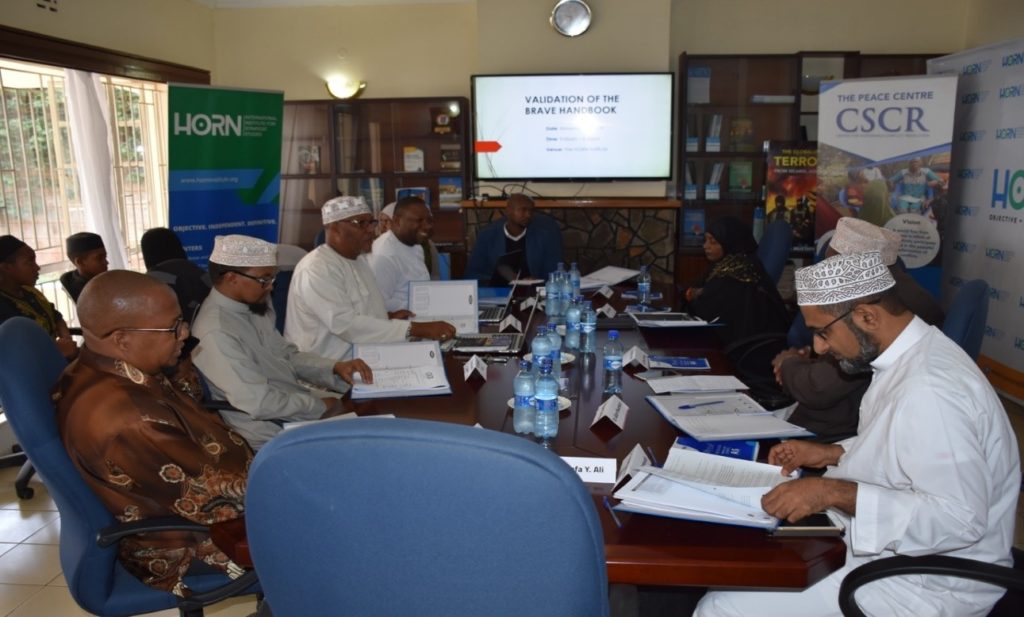
This is the premise the Center for Sustainable Conflict Resolution (CSCR) – known in Kenya as The Peace Center – has organized its work around for over a decade, well before “fifth generation” had a name. CSCR’s flagship program, Building Resilience Against Violent Extremism (BRAVE) – itself established by the author of the fifth-generation paradigmatic approach to contemporary terrorism, concludes that violent extremist ideology can only be defeated by people credentialed enough within that same tradition to take those concepts back. BRAVE’s strategy runs on two tracks it calls information asymmetries claw-back and ideological push-back. The first reclaims theological terms – jihad chief among them – that extremist recruiters have emptied of their actual meaning and refilled with their own. The second develops and deploys a family of counter-narratives – religious, alternative, ideological, strategic, ethical, and tactical – engineered to compete with, rather than simply denounce, the extremist narrative on the ground it has already claimed. The BRAVE Handbook that carries this framework into the field was built by, and for, the imams, sheikhs, madrasa teachers, youth leaders, and women of faith who are best positioned to deliver it, because they were already trusted before the program ever arrived.
The most exacting expression of that wager is Deep Dialogue, a component of CSCR’s D-PRIVE program (Diminishing the Prevalence of Radicalization and Violent Extremism) carried out from October 2021 and still carries on, alongside Kenya’s National Strategy on Countering Violent Extremism. Deep Dialogue does not counter-message a population; it works one person at a time, applying a technique rooted in Islamic jurisprudence called al muraja’atil fikriyyah, or doctrinal revision. A team of psychologists and religious scholars, including the BRAVE team, sat for extended sessions with returnees from al-Shabaab and Islamic State-affiliated networks, working systematically through nine meta-narratives that extremist recruiters lean on hardest: jahiliyya (the pre-Islamic “age of ignorance,” used to declare the current order illegitimate), takfir (excommunicating other Muslims as apostates), khilafah (the caliphate), al wala’ wal bara’ (loyalty and disavowal, used to sever a recruit from anyone outside the group), jihad, hijrah (migration, used to justify abandoning family and country), the dichotomy of dar al silm and dar al harb (the abode of peace versus the abode of war), tamkin (the felt necessity of an Islamic state), and hakimiyyah (the claim that legitimate authority belongs to the group alone).
The returnees who completed Deep Dialogue sessions had, without exception, organized their entire worldview around some combination of these concepts before treatment began. One had walked to market carrying his own bottle of water rather than touch anything handled by a person he considered impure, and would not pray behind an imam whose trouser hem fell below the ankle; by the end of his sessions, he was praying “everywhere, without discrimination,” and had voted for the first time in his life in the 2022 election. Another had believed killing a non-Muslim parent was religiously sanctioned; he came to recognize, through a presentation built around the very verses he had been taught to cite, that the passage had nothing to do with what he had been told. Someone else who was fully convinced that seccular education was absolutely prohibited, was made to understand his belief was flase and recently grauated with a university degree and has become a youth role model in peace building in Kenya. Across the case files, the pattern repeats with only the details changing: a conviction that unbelievers should be killed wherever found gives way to “there is no compulsion in religion”; a belief that man-made law is illegitimate by definition gives way to the recognition that the Prophet himself negotiated and honored treaties with governments that were not Islamic. None of this reformation happened through argument alone. It happened because the people doing the arguing had the religious standing to be listened to, and the patience to repeat a single doctrinal point three times over as many sessions until it actually displaced what had been taught in its place.
Deep Dialogue’s reach extended well beyond the returnees who completed it. The team ran seminars inside schools identified as vulnerable to recruitment, including one in Isiolo County where sixty students are known to have already joined al-Shabaab or Islamic State-aligned networks, walking students through the same concepts before those concepts could be exploited rather than after. It carried that same work into sermons and radio programming across Isiolo, Kwale, and Mombasa, reaching directly into mosques that had once served as recruitment grounds. Masjid Musa in Mombasa, formerly a headquarters of radicalization, is now a pulpit the BRAVE-trained sheikhs delivers alternative narratives to those of extremists’. Masjid Ridhwan in Kibundani, Kwale, once an al-Shabaab training site, has undergone the same reversal: BRAVE-trained sheikhs now mentor there the very young people the mosque once funneled toward recruitment.
And recognizing that no amount of theological correction survives a security environment built on mutual suspicion, the program convened sheikhs and security officers in Kwale, Marsabit and Isiolo, counties where each side had come to regard the other as an obstacle rather than a partner, and worked through the specific grievances—wrongful profiling, unexplained detentions, a fear among clergy that any cooperation with police would be read by their own communities as informing—that kept the two from ever sharing what each already knew.
None of this looks like a conventional counterterrorism program, and that is precisely the point the fifth-generation framework makes. An adversary that has learned to fund itself, govern locally, and fight for belief rather than only for ground cannot be answered by better detection or a larger coalition alone; it has to be met on the terrain it has actually claimed, which is theological, communal, and cognitive before it is ever military. CSCR’s premise, tested now across nearly a decade of BRAVE and the granular, person-by-person work of Deep Dialogue, is that the people equipped to hold that terrain were never in short supply. They were simply never invited into the counterterrorism conversation early enough, or trusted with the tools to compete on it. Fifth-generation extremism has changed the nature of the fight. The institutions capable of fighting it—the mosque, the madrasa, the sheikh who has known a family for a decade—were there all along.
Dr. Mustafa Y. Ali is the originator of the fifth-generation terrorism framework and the founder of the Center for Sustainable Conflict Resolution (CSCR / The Peace Center), Nairobi. He founded and conceptualized the BRAVE program, in which he serves as Convenor
Sheikh Ramadhan Aula is the Director of the Center for Sustainable Conclfict Resolution (CSCR), and program lead for BRAVE and Deep Dialogue